
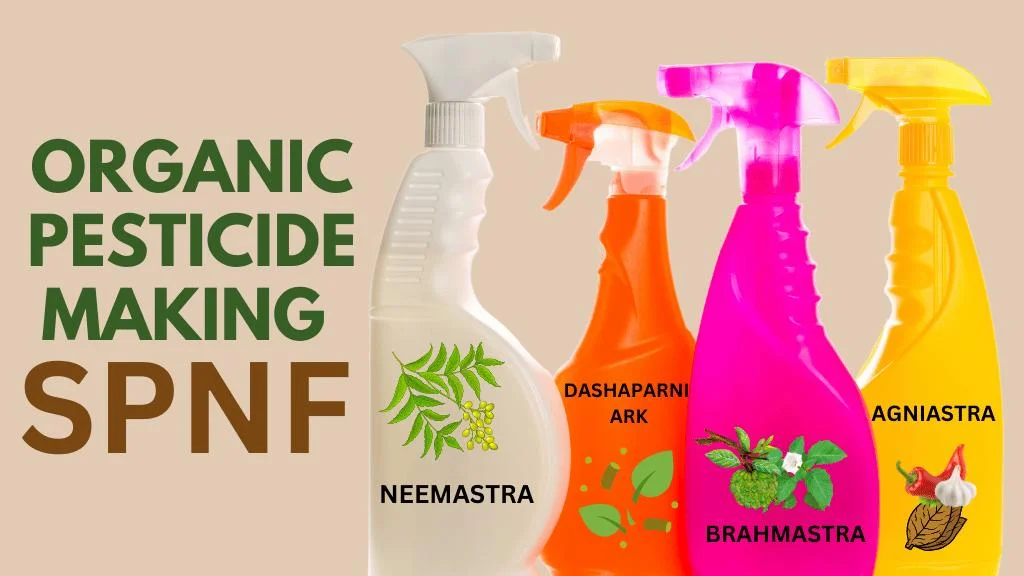
100% Organic Plant Protection Pesticides Making – SPNF
Tired of pests & fungi ruining your crops?
Switch to jaivik pesticides to keep your crops healthy and take a step towards a sustainable future.
Neemastra Preparation
Neemastra is used to prevent or cure diseases and kill insects or larvae that eat plant foliage and suck plant sap. This also helps in controlling the reproduction of harmful insects. It is very easy to prepare and is an effective pest repellent and bioinsecticide for Natural Farming.
Inputs Needed:

Preparation Steps:
- Step 1:Take 200 liters of water into a drum and add 10 liters of cow urine. Then add 2 kg of local cow dung. Next, add 10 kg of fine paste of neem leaves or 10 kg neem seed pulp.
- Step 2:Stir it clockwise with a long stick and cover it with a gunny bag. Keep it in the shade, away from sunlight or rainfall. Stir the solution every morning and evening in a clockwise direction.
- Step 3:After 48 hours, it is ready for use. It can be stored for up to 6 months. Do not dilute with water
- Step 4: Filter the prepared solution with a muslin cloth and apply directly on the crop through foliar spray.
Controls:
- All sucking pests, jassids, aphids, whiteflies, and small caterpillars.
Also Read: How to make Bijamrut
Brahmastra Preparation
Brahmastra is a natural insecticide prepared from leaves that have specific alkaloids to repel pests. It controls all sucking pests and hidden caterpillars present in pods and fruits.
Inputs Needed:

Preparation Steps:
- Step 1: Take 20 liters of cow urine in a vessel and add 2 kg of fine paste of neem leaves, 2 kg of paste prepared from leaves of karanj, custard apple, castor, and datura.
- Step 2:Boil on a small flame until one or two foams form. Stir in a clockwise direction, then cover the vessel with a lid and continue boiling.
- Step 3: After the second foam forms, stop boiling and let it cool for 48 hours. After 48 hours, filter the solution using a muslin cloth and store it. Preferably store in earthen pots or plastic drums under shade. The solution can be stored for up to 6 months.
Application:
- 6-8 liters of Brahmastra diluted in 200 liters of water for foliar spray on crops. Adjust ratios based on pest severity.
You may also like to read: Jivamrut making
Agniastra Preparation
Agniastra is a powerful insecticide that tackles stubborn pests.
Inputs Needed:

Preparation Steps:
- Step 1:Add 200 liters of cow urine to a container. Then add 2 kg neem leaves paste, 500 grams tobacco powder, 500 grams green chili paste, 250 grams garlic paste, and 200 grams turmeric powder.
- Step 2:Stir in a clockwise direction, cover with a lid, and boil until foam forms.
- Step 3: Remove from heat, keep under shade to cool for 48 hours. Stir twice a day during fermentation.
- Step 4: After 48 hours, filter with a muslin cloth and store. It can be stored for up to 3 months.
Application:
- 6-8 liters of Agniastra diluted in 200 liters of water for spraying. Adjust ratios based on pest severity.
You may Like: Where to find Go krupa amrutam?
Dashaparni Ark / Kashaya Preparation
Dashaparni Ark acts as a substitute for Neemastra, Brahmastra, and Agniastra. It is used to control all types of pests based on the level of infestation.
Inputs Needed:

Preparation Steps:
- Step 1:Take 200 liters of water in a drum, add 20 liters of cow urine and 2 kg of cow dung. Mix well, cover with a gunny bag, and keep aside for 2 hours.
- Step 2: Add 500 grams of turmeric powder, 200 grams of ginger paste, and 10 grams of asafoetida. Stir in a clockwise direction, cover with a gunny bag, and leave overnight.
- Step 3: The next morning, add 1 kg of tobacco powder, 2 kg of green chili paste, and 500 grams of garlic paste. Stir well, cover, and leave for 24 hours in the shade.
- Step 4: The following morning, add the paste of any 10 types of leaves to the mixture.
- Step 5:Stir thoroughly, cover with a gunny bag, and keep for 30-40 days for fermentation. Stir twice a day.
- Step 6:After 40 days, filter with a muslin cloth and use.
Application:
- 6-8 liters of Dashaparni Ark diluted in 200 liters of water for spraying.
Types of Leaves:
- Neem leaves – 3 kg
- Leaves of Pongamia pinnata – 2 kg
- Leaves of Annona squamosa – 2 kg
- Castor leaves (Ricinus communis) – 2 kg
- Datura leaves (Datura metel) – 2 kg
- Leaves of Calatropis procera – 2 kg
- Leaves of Vitex negundo – 2 kg
- Leaves of Datura stramonium – 2 kg
- Leaves of Nerium indica – 2 kg
- Leaves of Hibiscus rosa – 2 kg
- Mango leaves (Mangifera indica) – 2 kg
- Leaves of Lantana camara – 2 kg
- Leaves of Casia tora – 2 kg
- Leaves of Guava (Psidium guajava) – 2 kg
- Leaves of Pomegranate (Punica granatum) – 2 kg
- Leaves of Drumstick (Moringa oleifera) – 2 kg
- Leaves of Coffee (Coffea arabica) – 2 kg
- Leaves of Mahua (Madhuca indica) – 2 kg
- Cocoa leaves (Theobroma cacao) – 2 kg
- Leaves of Acacia nilotica – 2 kg
- Leaves of Psoralea corylifolia – 2 kg
- Leaves of Bitter Gourd (Momordica charantia) – 2 kg
Fungicide Preparation
A natural fungicide can be prepared with
- cow milk and
- curd.
Preparation:
- Step 1:Take 3 liters of milk and prepare curd from it
- Step 2: Remove the creamy layer and leave for 3 to 5 days until a grey layer of fungus forms.
- Step 3:Churn well, mix with water, and spray on infected crops after filtering.
Experts Corner
By choosing these natural alternatives, you not only protect your harvest from damage but also contribute to a healthier ecosystem. Strat using jaivik pesticide today will make your future happier!
Leave a Reply
Want to join the discussion?Feel free to contribute!